AI-powered triage
Give me the evidence and explain what happened, not a chatbot
A plain-language summary before anyone opens the backtrace, a search box that understands plain English, and a report that reads itself back to you, every sentence grounded in data the feature was actually given, each running on the operator's own Anthropic key against a real, bounded monthly allowance.
A plain-language summary before anyone opens the backtrace
An issue's own "Generate AI summary" button, once turned on for a project, sends its exception class, title, culprit, and most recent backtrace to Claude Haiku 4.5 and gets back one or two sentences explaining what likely went wrong, a suggested priority, and a couple of suggested labels, written for a teammate who hasn't looked at the backtrace yet. It's a suggestion shown on the issue, folded into a ticket's body the next time one's filed, never a decision made on anyone's behalf; nothing is resolved, reassigned, or filed automatically just because a summary was generated.
Only what a filed ticket would already show a human reader goes into the request, and only the already-scrubbed fields (see PII scrubbing) a ticket body itself sends; nothing raw, nothing beyond what was already going to leave ForgeOps anyway.
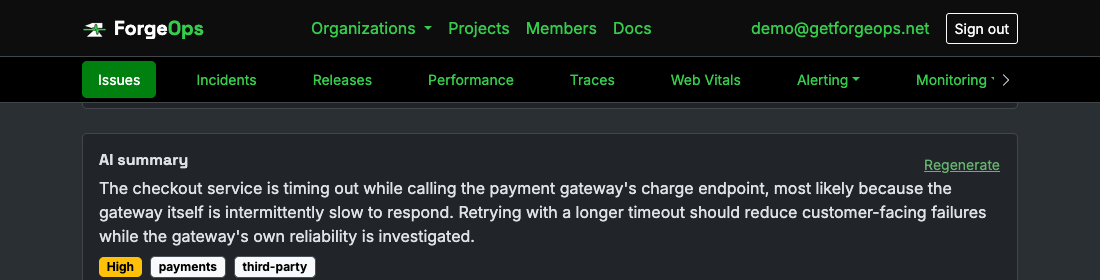
A plain-language explanation before anyone opens the backtrace, with a suggested priority and labels.
A search box that understands plain English
"Ask in plain English" sits next to the regular search field on a project's own issue list. A request like "unresolved payment errors from the last week, assigned to me" comes back as the exact same status, environment, release, sort, and time-range filters the dropdowns above the list already offer, not a separate search index or a different result shape to learn.
Nothing is trusted blindly: every field a translated result carries is checked against the project's own real statuses, environments, and releases before it's applied, and anything unrecognized, hallucinated, or simply not offered by this project is dropped rather than silently applying a wrong filter. A request that can't be understood at all falls back to a plain substring search on whatever was actually typed; there's no dead end, just a plainer result.
A report that reads itself back to you
Turn on "Add an AI-written summary to reports" for an organization and every report from then on, on demand or scheduled, opens with a couple of sentences of prose restating the numbers already below it: new issues, total events, tickets filed, downtime, who's carrying what. It's the same computation the report already runs, described once at the top instead of left for a reader to piece together from the tables.
It restates and contextualizes only the numbers it's actually given; it's never asked to claim a trend, a cause, or a comparison to a prior period, since a single report never computes one. This is the one AI feature gated at the organization level rather than per project, since a report can span every project in the organization at once.
A real allowance, not an unmetered key
Every call runs against the operator's own Anthropic API key, on Claude Haiku 4.5: bounded extraction and classification work (summarize a backtrace, translate a query, restate a set of numbers), not open-ended reasoning, so a fast, inexpensive model handles it well. That per-call cost is real regardless of who's asking, so each of the three features gets its own separate monthly allowance per organization rather than one shared, unmetered pool, free to every plan the way Slack or webhook delivery is.
None of the three ever raises a visible error if the Anthropic call itself fails, times out, or simply isn't configured; each one degrades to exactly what the feature would do without AI at all (a plain filed ticket, a plain substring search, a report with no narrative paragraph), the same graceful-degrade posture every other integration in this app already holds to.
See it on your own data
Free plan included, no credit card required. New organizations start with 14 days of Business.
Get started freeGet