Linked projects
Follow one request from your app to your API
Link the projects that call each other, and an app's error shows the backend error from the very same request, with one trace that runs from the tap to the database.
The error on the other side of the request
Your app's SDK sends the standard W3C traceparent header with requests made inside a trace, your backend's SDK continues it, and both put the same trace id on the errors they report. Once the two projects are linked, an issue lists the errors the other project raised in the very same request, and every occurrence names its match. A failed checkout in your app shows the gateway timeout in your API that caused it, not a separate mystery in a separate project.
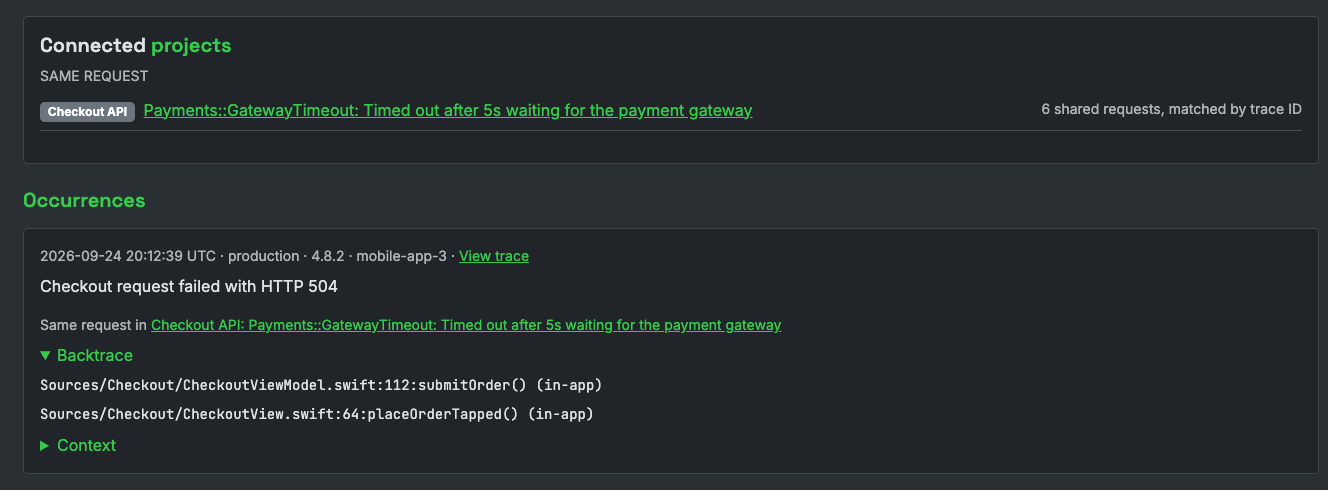
The API error behind an app's failed checkout, matched by trace ID.
One trace, end to end
When the request was traced, View trace opens it as one waterfall across both projects: the app's own step, its outbound call, and the API's request nested underneath it with its database and external calls, each project labeled where its part begins. A request that fails is always traced by the Ruby SDK, not only a slow one, so the error that matters most is the one you can open.
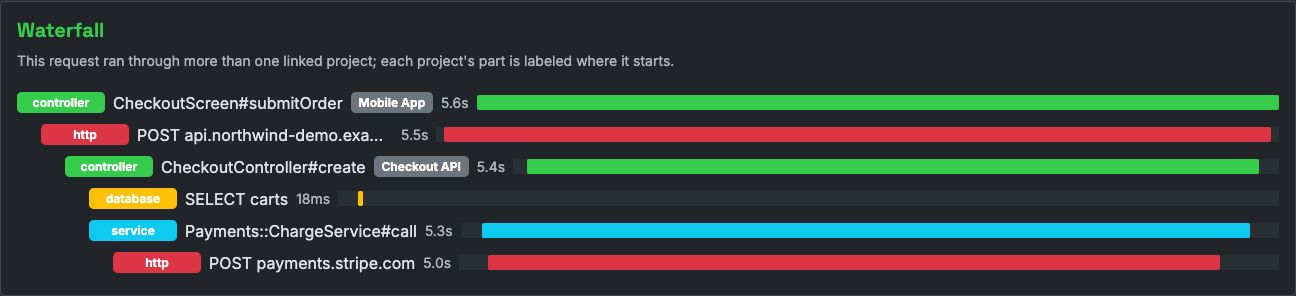
One request, across two projects.
Possibly related, and honest about it
Without a shared trace id, ForgeOps still looks for errors in a linked project that happened within five seconds of this issue's own occurrences, and lists them as possibly related only once they've lined up more than once, noting when they hit the same endpoint too. Timing alone can be coincidence, so they're labeled that way and never merged into the issue.
Which SDKs take part
The backend side is the Ruby SDK (0.12.0 and up), which continues an incoming trace and passes it on to whatever it calls. On the calling side, Swift (0.4.0), Android and Kotlin (0.8.0), and React Native (0.10.0) send the header on requests made through a trace, and React Native adds it on its own to requests made while a trace is open. Every one of them can limit which hosts get the header.